Face shape guide
How Face Shape Analysis Works: Method, Quality, and Limits
Understand what our browser-based face shape detector compares, how it checks photo quality, and how to verify a result with measurements.
Analyze my face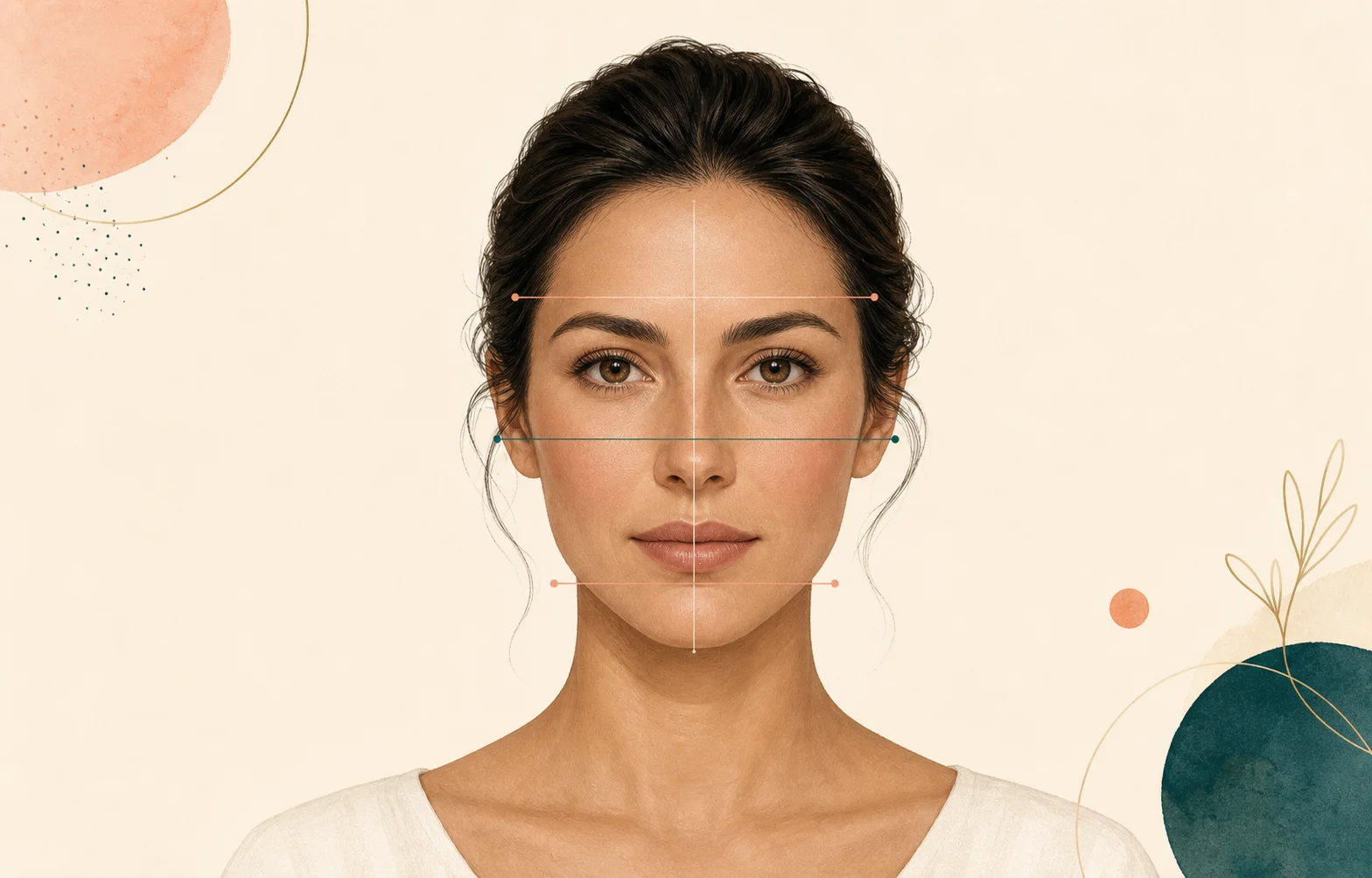
Face shape analysis is a comparison of visible proportions. It is not identity recognition, a beauty score, or a medical assessment. The detector looks for a broad outline that resembles one or two familiar styling categories: oval, round, square, heart, diamond, oblong, or triangle. These names simplify a continuous range of real faces, so a nearby alternative is often useful rather than a sign that the analysis failed.
The current detector runs in your browser. Your photo is decoded locally and passed to a local landmark model. The site does not need to upload the image to classify the outline. After analysis, the source image and landmarks are not placed in the result URL or saved as a public page. Read the full privacy policy for the product's data-handling commitments.
What the browser analyzes
The browser first locates one face and a set of reference points around it. The detector uses selected relationships among those points to estimate face length, cheekbone width, forehead width, jaw width, and the transition from the cheeks toward the chin. It normalizes the geometry so that moving the same face within the frame, or using a larger image of the same neutral view, should not change the underlying proportions.
No single feature decides the result. A pointed chin does not automatically mean heart, and a strong jaw does not automatically mean square. The classifier compares the combined pattern. A face that is moderately longer than wide with a gradual taper may sit near oval. A distinctly longer pattern may sit closer to oblong. Similar visible length and width can suggest round or square, with the jaw transition helping to separate them. Upper-face width, cheekbone width, and lower-face width help distinguish heart, diamond, and triangle patterns.
Each pattern receives a relative comparison score. The closest pattern becomes the primary result. When the next pattern is also close, it appears as a nearby shape. The site intentionally exposes that uncertainty instead of pretending that every face belongs to one exact category.
The manual face shape calculator follows the same general idea with values you enter yourself. It uses ratios, so centimeters and inches produce the same result when every measurement uses the same unit. The photo and manual methods are related, but they are not identical: one estimates from visible landmarks while the other depends on how you place the measuring tape.
Photo quality checks before classification
A result is only useful when the outline is visible. Before classification, the detector checks whether the image format and dimensions are usable, whether exactly one face was found, whether the face occupies enough of the frame, and whether the head appears reasonably level and forward-facing. It also checks that important outline points are present and that the forehead, cheeks, jaw, and chin are not cut off by the image boundary.
Blocking problems stop the classification and show a retake instruction. For example, a strongly turned head changes the apparent widths on each side, two faces make it unclear which person should be analyzed, and a very distant face does not provide enough reliable geometry. A slightly distant but otherwise usable face can produce a result with a quality note rather than a false claim of perfect confidence.
Lighting, blur, hair, expression, filters, and camera perspective still matter. A landmark model may locate a face in a photo whose outline is partly hidden. That is why the product also shows preparation guidance: use even light, keep a neutral expression, move hair away from the outline, hold the camera near eye level, and avoid a very close wide-angle selfie. A technically accepted photo is not guaranteed to represent your everyday proportions perfectly.
For a careful manual alternative, follow the how to find your face shape guide. It explains how to compare length, the widest area, the forehead-to-jaw direction, and the jaw transition without relying on one feature.
How to verify a result
Start with the primary result and read the observable signals. If a nearby shape appears, open the comparison between those two patterns. Focus on the specific relationship that separates them rather than comparing celebrity photos or trying to match every detail.
Then use the manual calculator as a second method. Measure the forehead, cheekbones, jaw, and face length twice, keep all values in one unit, and choose the jawline description that best matches a neutral view. When you open the calculator from a private photo result, the browser can compare the two derived summaries without transferring the photo.
A strong match means both methods selected the same primary pattern. A close boundary means one method selected a shape that the other treated as a nearby alternative. Different readings are also informative. They often suggest that the photo angle, hair placement, or one manual measurement should be checked again. They do not mean that one method can reveal an objectively permanent label.
You can begin with the private face shape detector, then repeat the process with a second neutral photo if the first result feels surprising. Consistency across neutral inputs is more useful than repeatedly changing the angle until a preferred label appears.
Limits of face-shape analysis
Face shape categories are styling conventions, not biological diagnoses. Real outlines vary continuously, can be asymmetric, and can change in appearance with age, expression, hairstyle, facial hair, camera distance, or weight changes. The detector does not assess health, attractiveness, ethnicity, gender, age, or identity. It should not be used for medical, legal, security, or eligibility decisions.
The result is best used as a vocabulary for comparing hairstyles, glasses, and nearby outline patterns. Personal preference, hair texture, prescription fit, maintenance, and comfort matter more than following a rule assigned to a face shape. If the result and your own observation disagree, keep the parts of the guidance that are useful and ignore the label.
Browser and device differences can also affect whether the local model loads and how quickly it runs. If analysis is unavailable, try a current browser or use the manual method. The service may improve its quality thresholds and classification profiles over time, but it will continue to present results as estimates with explicit limitations rather than as facts about a person.