Face shape guide
What Is My Face Shape? A Practical Way to Tell
A simple, non-judgmental way to compare forehead, cheekbone, jaw, and face-length proportions.
Analyze my face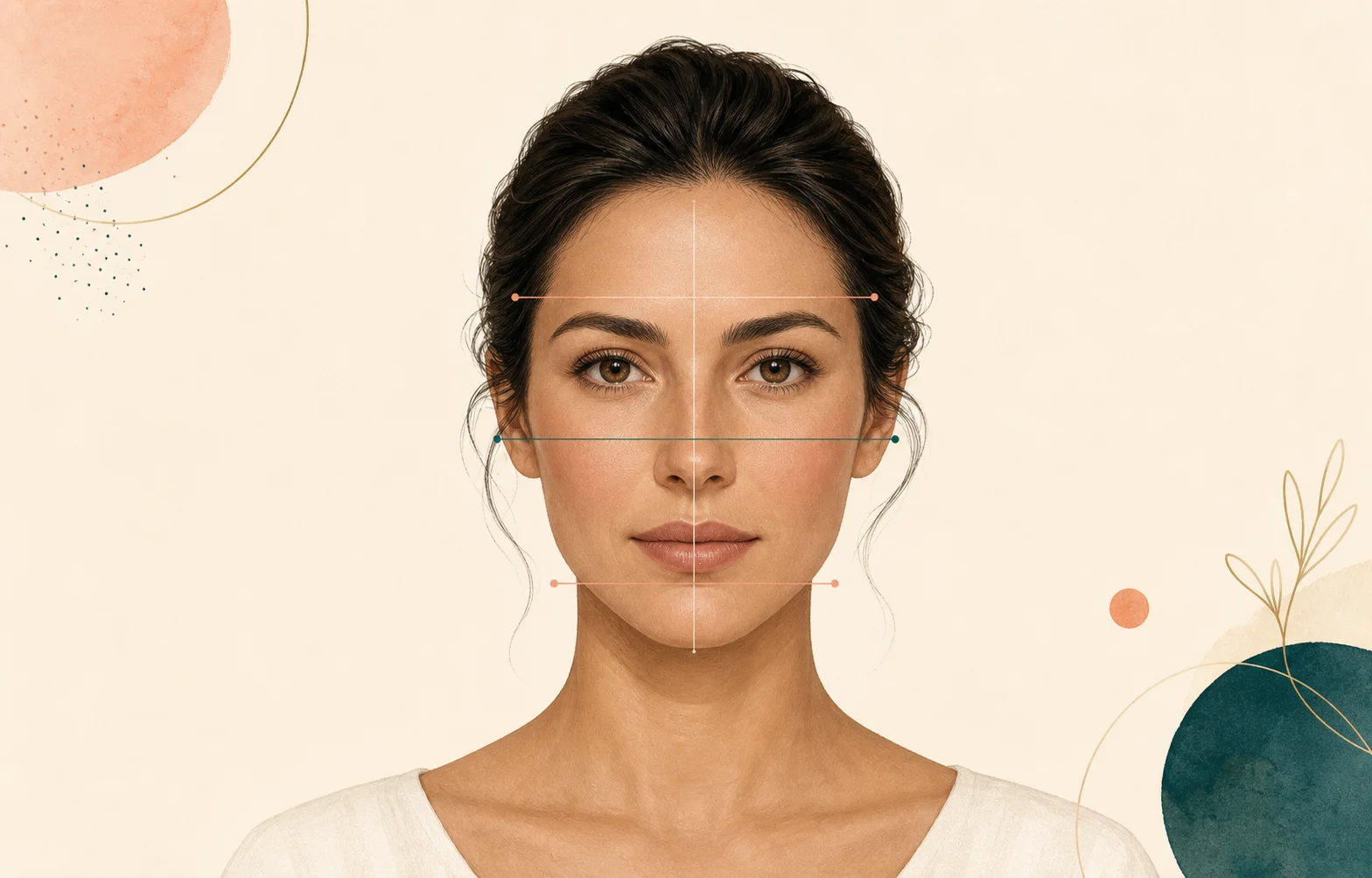
What makes up a face shape?
If you are asking, "What is my face shape?", start with the outline you see from the front. A face shape is a convenient description of how face length, forehead width, cheekbone width, jaw width, and jawline contour relate to one another. It is not a beauty category, a diagnosis, or a fixed identity. Many people sit close to the boundary between two familiar labels.
Use a level, face-forward photo in even light, or stand directly in front of a mirror. Move hair away from the temples and jaw when you can. Then step back far enough to see the whole outline. A single sharp jaw, full cheek, or pointed chin is useful information, but it does not decide the shape by itself.
Start by noticing five relationships:
- Overall length: Does the face read close to as long as it is wide, or clearly longer?
- Forehead width: Does the upper face feel broad, narrow, or close to the width of the cheeks?
- Cheekbone width: Are the cheeks the widest visible point, or part of a more even outline?
- Jaw width: Does the lower face narrow, stay even, or open outward?
- Jaw transition: Does the line from cheek to chin feel curved, direct, angular, or softly tapered?
Those patterns give you a more useful starting point than trying to match a single feature to a label.
The seven common labels
The seven face shape guides use a small shared vocabulary so you can compare outlines consistently. The descriptions below are tendencies, not rules that every face has to satisfy.
| Face shape | Pattern to look for |
|---|---|
| Oval | Longer than wide, with a gentle taper from the cheekbones toward a softer jaw. |
| Round | Similar visible length and width, with curved transitions through the cheeks and jaw. |
| Square | Similar visible widths through the forehead, cheeks, and jaw, with a more defined lower contour. |
| Heart | More width at the forehead or upper cheeks, narrowing toward a smaller chin. |
| Diamond | Cheekbones create the widest point while the forehead and jaw read narrower. |
| Oblong | Noticeably longer than wide, often with relatively even side lines from temple to jaw. |
| Triangle | A narrower upper face that becomes broader through the jaw. |
Labels can overlap in useful ways. An oval and oblong outline can both have a soft jaw, but oblong usually has a stronger vertical first impression. A round and square outline can both look close in length and width, but the jawline transitions differently. A heart and diamond outline may both taper to the chin, while the location of the widest point separates them.
When two labels sound right
Close calls are normal. First compare the relationship that creates the uncertainty instead of looking for a perfect match. For example, use the oval and oblong comparison when length is the main question, or compare round and square when the lower contour feels ambiguous. The heart and diamond comparison and triangle and square comparison offer the same kind of focused check.
Lighting, hair placement, expression, and camera position can also change what you notice. It is more reliable to compare two neutral views than to force one selfie into a category. The manual face-shape method walks through the observation sequence in more detail.
Use the label as a starting point
Once a pattern feels most likely, read its guide and any close alternative. The useful outcome is not a permanent verdict; it is a clearer description of the proportions you want to understand. For a browser-only second perspective, analyze a photo privately. The result is an estimate, and a nearby second shape is a reason to explore both explanations rather than a sign that anything is wrong.